For most of the last century, the command center was easy to recognize.
Maps covered walls. Radios filled desks. Operators sat in rows. Information physically traveled toward the room where decisions were made.
Today, the room is changing.
A vessel may observe one part of an environment. An aircraft another. A cyber system detects activity neither can physically see. Logistics systems know what is available. Intelligence systems know what has happened before.
The modern operational picture no longer arrives from a single direction.
It has to be assembled.
And increasingly, it has to be assembled in seconds.
The New Bottleneck
The challenge is no longer simply seeing farther.
Modern sensing systems already generate extraordinary visibility.
The harder problem is determining how separate observations relate to one another.
A detection becomes more meaningful when it can be understood alongside location, history, identity, mission context, confidence and other evidence.
This is why the future command environment may be less defined by enormous rooms filled with screens and more by the intelligence architecture underneath those screens.
A decision maker may eventually carry an operational picture that once required an entire facility.
But portability alone is not intelligence.
The information still has to be trusted.
The Human Doesn't Disappear
Artificial intelligence introduces an important temptation: automate the decision because the machine can process more information.
But high consequence environments demand something more sophisticated.
AI can help identify relationships.
It can surface anomalies.
It can compare enormous volumes of information faster than a human analyst.
But a consequential decision still carries questions machines cannot simply erase:
Where did the evidence originate?
What assumptions produced the recommendation?
What evidence disagrees?
What changed since the last assessment?
Who is accountable for the action?
The strongest operational systems of the future may therefore be neither purely human nor purely autonomous.
They will be systems in which machine speed strengthens human judgment.
From Command Center to Decision Layer
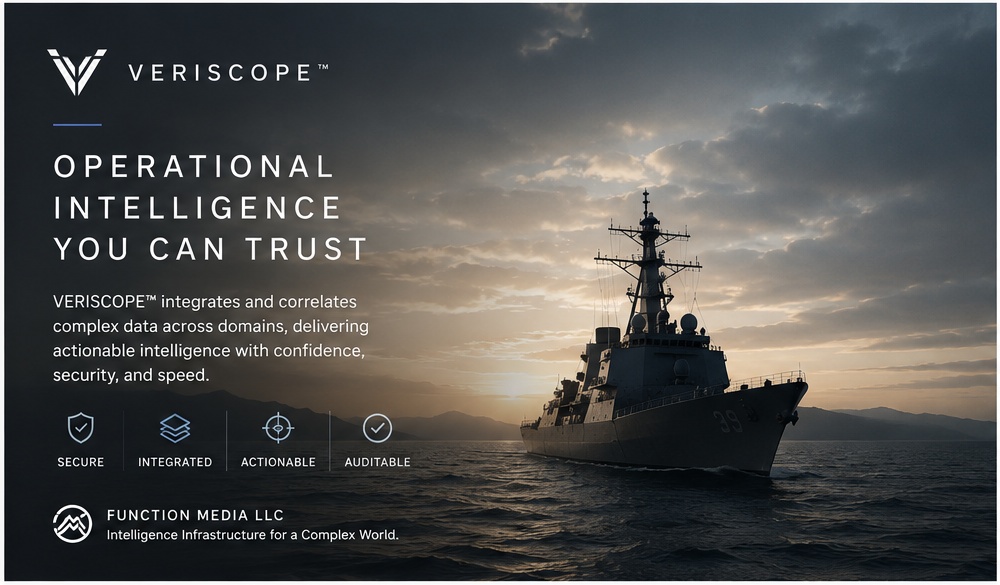
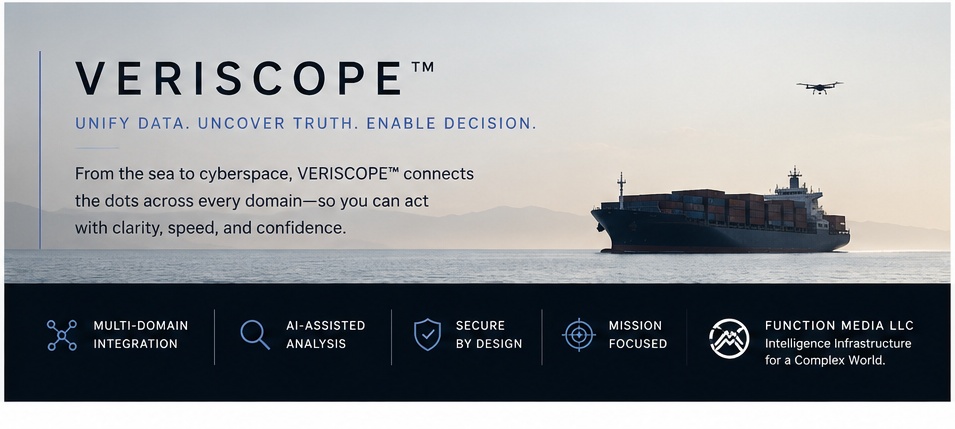
This is the problem space behind VERISCOPE™, developed by Function Media LLC.
VERISCOPE explores operational intelligence as a connected decision layer: bringing fragmented information into context while preserving the evidence necessary for human oversight.
Its underlying premise is deliberately simple.
In complex environments, knowing what happened is useful.
Knowing why the system believes it happened is more powerful.
And knowing what evidence supports that conclusion may be essential.
The command center isn't disappearing.
It is becoming distributed.
And the most important part may eventually be the part we cannot see:
the intelligence connecting everything together.